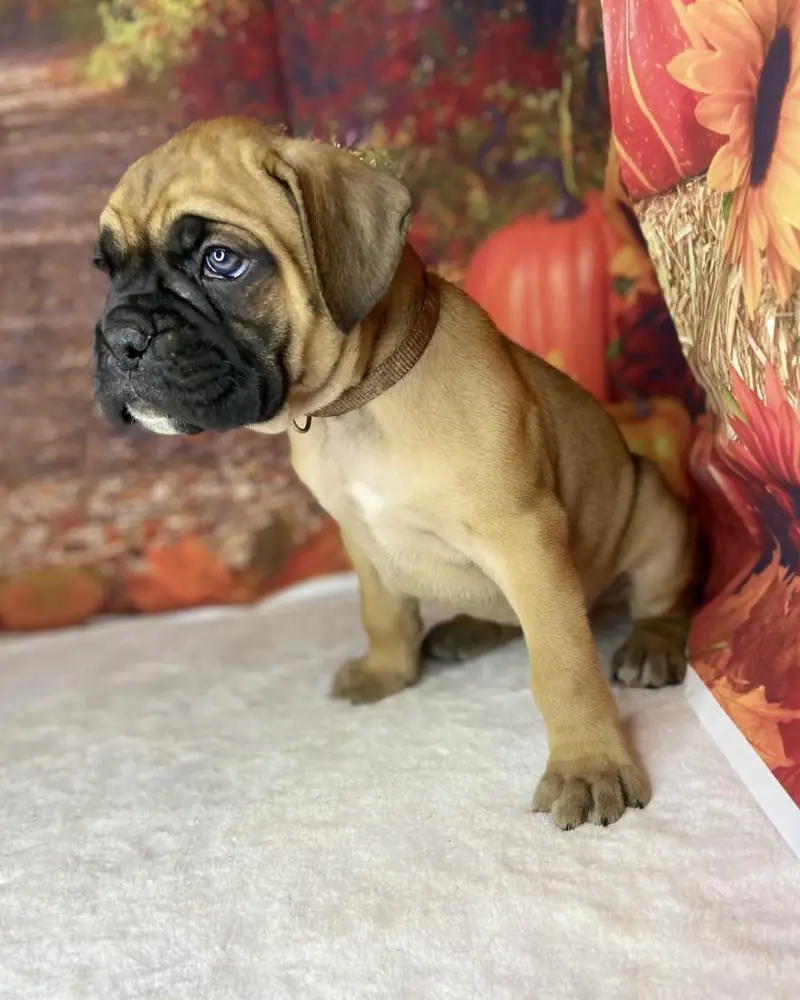
Mason
- SexMale
- ColorFawn
- Age9 weeks
$700Available
From Draco Boxers in Macedonia, Ohio. Updated 30 October 2026.
Bringing home a Boxer puppy goes best when the first two weeks are a little dull: one potty spot, fixed meal times, a crate beside your bed and Boxer puppy training in two-minute bursts between naps. Our puppies leave us at 9 weeks old, so the advice below follows a 9-week-old through its first month with you.
We live in Macedonia, between Cleveland and Akron, so expect notes on snow, rock salt and sticky Ohio summers. Still choosing? See the Boxer puppies available now.
Choose one room as your puppy's base for the first weeks: a kitchen or family room with a hard floor, fenced with a baby gate so your puppy can still see the family. Then look at it from a foot off the floor, because anything at that height gets chewed:
For the dog crate, buy the adult size and fit a divider while your puppy is small: a 42-inch wire crate holds most grown Boxers, and a smaller female may suit a 36-inch one. Set the divider so your puppy can stand, turn and stretch out, with no spare corner for a bathroom.
Book your vet for the first three days, since the check has to happen within 72 hours. Everything to buy is on our puppy supply list.
That depends on how your puppy travels. If you collect in Macedonia, we go through feeding, sleep and house training together before you leave. Akron is about 25 minutes away and Cleveland about 30 minutes, while Columbus and Pittsburgh are close to two hours. Bring a crate or carrier lined with a towel, and if you stop, keep your puppy off rest-area grass, where a puppy partway through its vaccines can pick up parvovirus.
With ground delivery, a pet transport handler brings your puppy to your door. With a flight nanny, you collect it at your nearest airport, so bring a carrier for the car.
At home, carry it straight to the potty spot, praise it the moment it goes, and keep the welcome to the household for now. Feed the food it already eats: the starter kit has a few days of it, so buy the same food before that runs out, and blend in any new food over about a week.
Expect a few tears and one trip outside. Your puppy has always slept curled against its littermates, so a night alone is new.
Night trips fade as the bladder grows. By day, make the crate a good place: serve meals in it, drop a chew in, and use it for naps after play. Young puppies need a lot of sleep, and a tired Boxer puppy is a nippy one.
Several months, and up to a year before it is completely reliable. Most puppies make clear progress within a few weeks, and the AKC's training timeline for Boxers expects one to be fully potty trained by its first birthday. Knowing where to go comes long before the bladder can always wait.
A cautious rule of thumb is one hour of holding per month of age, so at 9 weeks, two hours at most while awake, and much sooner after these moments:
| When | What to do |
|---|---|
| The moment it wakes | Straight outside, before breakfast |
| After each meal | Outside within 15 minutes |
| After each nap | Outside as soon as it stirs |
| During play | Every 20 to 30 minutes, or when it stops to sniff and circle |
| In the night | One trip if it wakes and cries |
Go with your puppy every time, on the leash, to the same patch, and reward it the second it finishes. An accident is a timing note, not bad behavior: clean it with an enzyme cleaner and go out sooner next time.
Plan for snow, because a fall puppy meets its first one within weeks. Boxers have a short, thin coat, and the American Boxer Club notes they are not built for very hot or very cold weather. Lake-effect snow off Lake Erie can bury a yard overnight, so make each trip quick:
Sidewalks add salt. Rock salt and many ice melts sting the paw pads, can crack them, and upset a puppy's stomach when it licks its feet. Wipe all four paws with a damp cloth after every walk, and use a pet-safe ice melt on your own steps. Our page on Boxer puppies in Ohio has more on life with a Boxer here.
Because a puppy explores and plays with its mouth, and Boxers play hard. Its littermates taught it when a bite was too rough, and now that lesson is yours, from day one.
Teething brings a second round. Baby teeth start dropping out at around three to four months, and all 42 adult teeth are usually in between six and eight months. Offer firm rubber chews or a wet washcloth twisted and frozen, and skip antlers and real bones, which can crack a tooth.
In tiny sessions, with food, from the first evening. A 9-week-old focuses for only a minute or two, so train for two or three minutes a few times a day, using part of each meal as rewards. Boxers love people and games, so make lessons feel like play, as our guide to Boxer temperament explains.
Use rewards, not force: a Boxer wary of your hands learns less and mouths more.
Less than its energy suggests. In large breeds the growth plates can stay open until around 16 to 18 months, so avoid repeated hard impact until then, such as jogging on pavement or leaping out of an SUV. Our Boxer size and growth guide shows how fast a puppy fills out.
The UK Kennel Club's rule of thumb is five minutes of structured exercise per month of age, up to twice a day: for a 3-month-old, a 15-minute walk morning and evening. Free play on the lawn comes on top.
A short muzzle also makes a Boxer overheat fast, and a humid July afternoon in Akron is plenty, so walk early and late in summer. Once your vet clears longer outings, the flat Towpath Trail through Cuyahoga Valley National Park is a good place to build distance.
Within 72 hours of arriving home. Our 1-year health guarantee asks for this visit, and it gives your vet a healthy baseline to work from. Every puppy sees a vet before it leaves us, but your clinic takes over from here.
Take the health record from the starter kit, which lists the vaccinations and deworming so far, and a stool sample if the clinic asks. Expect the vet to:
Keep the records from every visit. If a vet ever diagnoses a condition the guarantee covers, tell us within 7 days, with the written diagnosis and records. For smaller worries, send us a message.
Fairly easy, if the routine never changes. Most catch on to the idea of one outdoor spot quickly; the hard part is getting them there often enough while they are small.
The AKC's general advice for puppies of 6 to 12 weeks is four small meals a day, dropping to three somewhere between three and six months. Go by the amounts on the bag and your puppy's shape.
A slightly loose stool is common after a move. Call your vet the same day for blood, vomiting, a puppy that refuses food, or diarrhea lasting more than a day, because young puppies dehydrate quickly.
Ask at the first vet visit, since it depends on the vaccine series. Until then, stay in your own yard and carry your puppy when you want it to see traffic, shops and people.
That is your call, but start with the crate. A 9-week-old cannot climb down safely or warn you it needs to go, and keeping a grown 70-pound Boxer off the bed later is harder than never starting.
 Getting Your Puppy HomeCollect in Macedonia, ground transport or a flight nannyRead more
 Health GuaranteeWhat the 1-year written guarantee coversRead more
 How Big Do Boxers Get? From Puppy to Full Grown BoxerHow big do Boxers get? Adult height and weight for males and females, a growth chart from 6 weeks to 2 years, when growth...Open the guide
 Boxer Temperament: What a Boxer Is Like at HomeBoxer temperament from a home where the dogs live indoors: children, cats, visitors, time alone, energy by age...Open the guide
 How Long Do Boxers Live, and How Can You Help?Boxer life expectancy is 10 to 12 years on average. What vet research shows, what most often cuts it short, and what...Open the guide
Look through the puppies we have now, and send us whatever questions you still have.