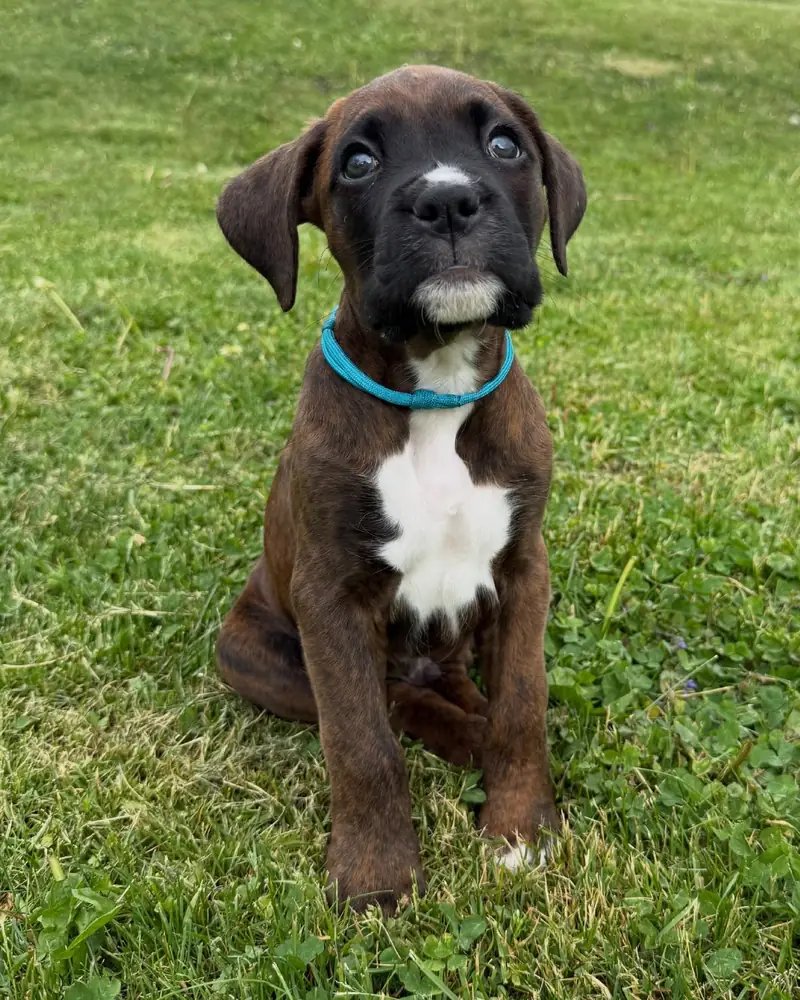
Sam
- SexMale
- ColorBrindle
- Age9 weeks
$700Available
Our brindle Boxer puppies now, and what the color means as a puppy grows.
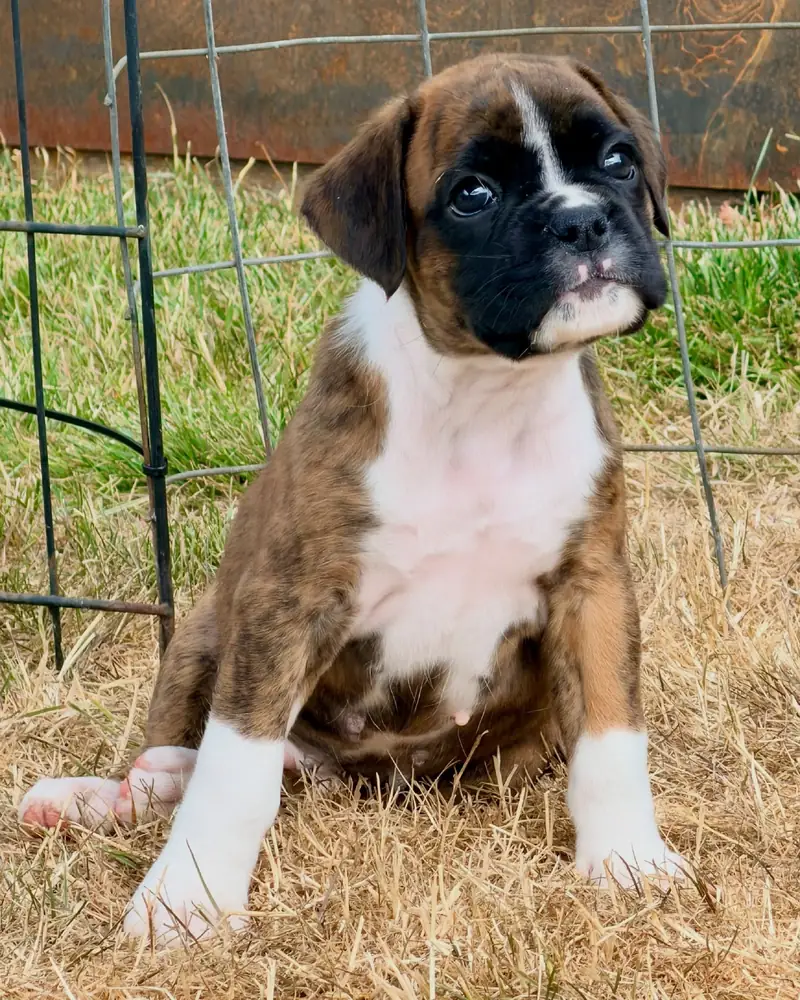
Stripes are what set a brindle Boxer apart: black lines over a fawn coat, sometimes only a few, sometimes so many that the fawn nearly disappears. Of the two Boxer colors in the AKC standard, brindle is the striped one, and two of our puppies wear it: Sam, a dark brindle boy with a white bib, and Cassandra, a flashy brindle girl.
Brindle Boxer puppies cover that whole spread, light, dark and reverse, and a judge calls every one of them brindle. Our litters bring brindles and fawns together, so a brindle puppy may well have fawn brothers and sisters.
Black stripes on a fawn background, with the fawn still visible. The AKC standard runs from "sparse but clearly defined" stripes at the light end to striping so dense that the fawn "barely, although clearly, shows through" at the heavy end. Everything between counts as brindle.
Under the stripes sits an ordinary fawn coat, and its shade, light tan through mahogany, colors the whole look: a light base makes a bright, golden brindle, and a mahogany base a deeper one. Along the side of a brindle, the stripes run with the ribs. The European standard describes them that way and asks for a clear contrast against the fawn.
Yes. Picture a puppy that looks black from across the room, then shows thin fawn lines along its ribs up close. That is a reverse brindle. Nothing is actually reversed: the stripes are still black and the base is still fawn, but there are so many stripes that the fawn becomes the thin line. The standard notes that heavy striping "may create the appearance of reverse brindling," and judges treat these dogs as brindle.
What decides it is fawn you can actually see, even a little along the ribs or down the legs. That is also the honest answer to most "black" Boxer listings: the puppy is a reverse brindle with its fawn tucked out of sight.
Sam is a good example: deep, dense striping, a black mask and a white bib. Dark brindle sits between an everyday brindle and a reverse one, and indoors a coat like his can read almost black. The American Boxer Club says much the same of heavy brindles, and of puppies most of all: the black can seem to be the base color.
Daylight sorts it out. Take the puppy out onto the lawn and the fawn shows itself in the gaps between stripes, along the ribs and legs first. It usually becomes plainer still as the adult coat grows in. On a face this dark, the mask and stripes run together around the eyes and muzzle, and the whole face reads as one dark shade.
Yes, and a striped dog with white on the face, chest and feet is called a flashy brindle, or a brindle and white Boxer. Cassandra is one. Sam's white bib is the same kind of marking on a smaller scale. A plain brindle with little or no white is just as correct, and the standard says it should not lose points for that.
Show judges allow white on up to a third of the coat and prefer to see none of it on the flanks or the back. A blaze can eat into the mask and reach up between the eyes, provided the face still looks like a Boxer's. A coat that is mostly white with a few brindle patches is another matter: past the one third line the standard treats it as white, and people often call that dog a check.
The stripes stay, and so does the color: a brindle puppy is a brindle for life. What changes is how easily you can read the pattern. Dense striping that looks nearly black in the whelping pen often opens up as the adult coat comes in, letting more fawn show between the lines, while a light brindle keeps its clear stripes on a fawn base.
If you are weighing up a dark puppy from photos, ask us through the contact form how its fawn looks in daylight, and we will tell you what we see. White markings hold their place and usually look a little smaller once the chest fills out. In later years, a dark brindle's muzzle shows its first gray hairs more plainly than a fawn's does.
Yes. The European standard, used for German Boxers, names the same two colors as the AKC: fawn and brindle. The European wording is a little stricter on pattern: stripes "too close together or too sparse" count as faults, which points toward a clear, medium brindle. The AKC standard welcomes the whole range from sparse to heavy, so a German brindle and an American one are the same color, judged with slightly different eyes.
Two facts drive it: brindle beats fawn, and a brindle may hide a fawn copy that it can pass on. Together they give a short table:
| Parents | Brindle puppies possible? | Fawn puppies possible? |
|---|---|---|
| Fawn and fawn | No | Yes, every puppy |
| Fawn and brindle | Yes | Only if the brindle carries fawn |
| Brindle and brindle | Yes | Only if both carry fawn |
Turn the table around and one rule falls out: no brindle puppy is born without a brindle parent. Stripe density is a separate question, settled by other genes, which is why brindle littermates can look so different. A reverse brindle is no exception and inherits brindle the same way. Our fawn Boxer guide covers the other color.
No. Stripes say nothing about temperament. Sam and Cassandra share the description we give all our puppies, fawn or brindle: warm, cool-tempered and gentle with family. That comes from the puppy, its parents and a home upbringing, and the Boxer temperament guide covers it in full.
Care is the same as for any Boxer, with one exception: white skin. A white bib or blaze often sits over pink skin that can burn, so on a hot, bright day a flashy brindle is better off under a tree or on a covered porch than out on the open lawn. In sunnier states, such as Arizona, where one family took two of our brindle puppies home together, shade matters even more for any dog with white markings. To see who is ready now, look through the available puppies, or go back to the Boxer colors overview to compare brindle with fawn.
Yes. Fawn and brindle are the only two colors in the standard, so a striped coat is as correct as a solid one.
Sometimes, though every Boxer should have one. It is easy to pick out on a lightly striped dog and almost vanishes into the striping on a reverse brindle.
No, it is a very dark brindle. The word implies the fawn is gone, covered over by black, and that is the problem: the standard needs the fawn to show, so the American Boxer Club would rather breeders said seal or black brindle.
No. Black brindle is a name for a heavy brindle with fawn still showing. The breed has no gene for solid black, so a dog that is black all over has another breed in it somewhere.
A brindle at the light end, with only a few stripes on a fawn coat. It still counts as brindle, since any clearly defined black stripe takes a dog out of fawn.
Not in color or stripes. The difference is size, with males growing bigger, as the Boxer size chart shows.
Apply with the puppy's name, or ask us anything first.