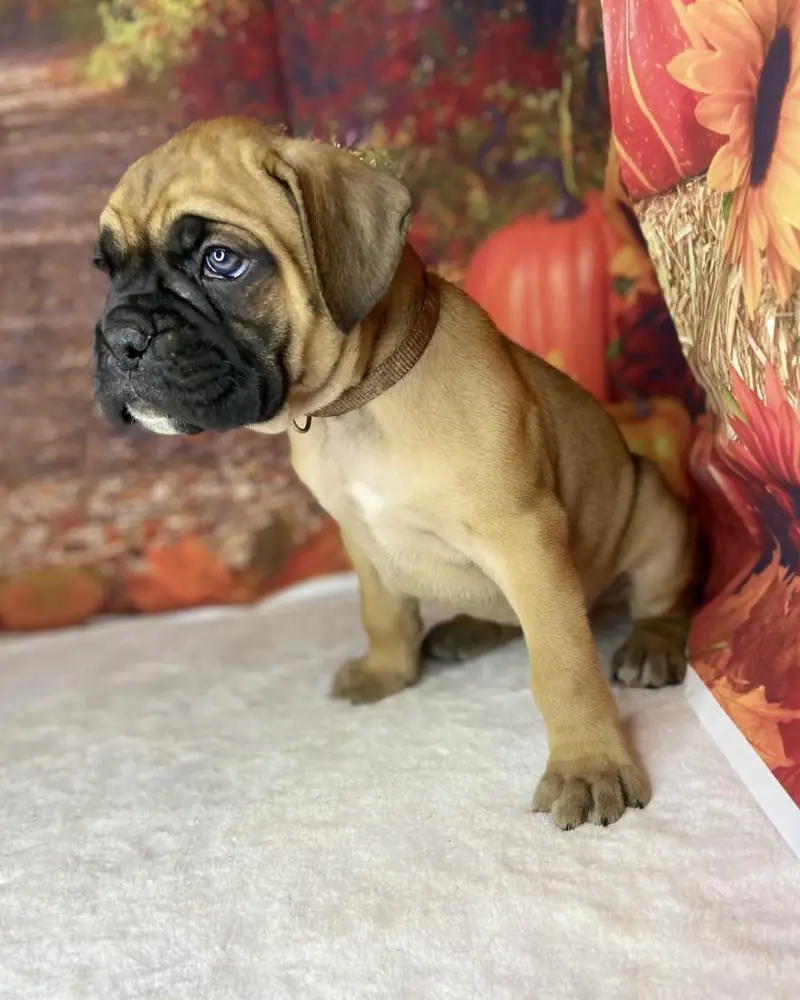
Mason
- SexMale
- ColorFawn
- Age9 weeks
$700Available
From Draco Boxers in Macedonia, Ohio. Updated 30 October 2026.
How big do Boxers get? Most adults weigh 50 to 80 pounds. Males sit at the top of that, typically 65 to 80 pounds on a frame 23 to 25 inches tall at the withers, while a female usually weighs about 50 to 65 pounds and measures 21.5 to 23.5 inches. The puppy you take home at 9 weeks is a small part of that, and most of the gap closes before the first birthday.
Every litter of ours is born and raised in our house in Macedonia, Ohio, so the first nine weeks happen here. From the day your puppy leaves, the story is yours, and here is how it usually goes: a Boxer growth chart for males and females, the months when growth slows down, and the simple hand test that tells you whether your Boxer is the right weight.
The growth chart further down has a row for 8 weeks and a row for 10 weeks, and a 9-week puppy falls between them: roughly 10 to 20 pounds for a male, with females a pound or two lighter at each end.
That is light enough to carry to the car and heavy enough to feel by the time you get there. At this age a Boxer is mostly head, paws and belly, and the long legs and deep chest of the adult are still a year or more away.
Littermates seldom weigh exactly the same, and a pound or two of difference at 9 weeks is normal. Your own vet will put the puppy on the scale at the first visit, which our health guarantee asks you to book within 72 hours of arrival. Write that number down: it is the first point on your own growth line.
Your puppy also arrives with a docked tail and cropped ears, and we explain the reasons in Boxer tails and ears.
| Age | Males (pounds) | Females (pounds) | Stage |
|---|---|---|---|
| 6 weeks | 6 to 10 | 5 to 9 | With mom and the litter |
| 8 weeks | 10 to 16 | 9 to 14 | Final week with the litter |
| 10 weeks | 14 to 20 | 12 to 18 | About a week in your home |
| 3 months | 20 to 28 | 18 to 25 | Fast growth |
| 4 months | 28 to 36 | 24 to 32 | Fast growth |
| 5 months | 34 to 44 | 30 to 38 | Fast growth, about to ease off |
| 6 months | 40 to 50 | 35 to 44 | Around two thirds grown |
| 9 months | 52 to 64 | 44 to 55 | Leggy teenager |
| 12 months | 58 to 72 | 48 to 60 | Close to full height |
| 18 months | 62 to 78 | 50 to 64 | Height done, still filling out |
| 2 years | 65 to 80 | 50 to 65 | Usual adult weight |
No breed body publishes an official chart, neither the AKC nor the American Boxer Club. These ranges are rough typical weights scaled back from the adult figures, and healthy puppies land above or below them all the time.
What matters is the line, not the dot. A puppy that keeps climbing week after week is on track wherever it sits, and one from large parents often runs high from start to finish. If the climb stalls, or the scale goes backward, call your vet.
Quickest from the day they come home until about 5 or 6 months. Six months is the turning point: by then a typical Boxer has already put on about two thirds of its adult weight, so the last third is spread over another year or more.
That slower stretch brings an awkward spell. Somewhere between 6 and 18 months a lot of Boxers look all legs and ribs, with a chest that has not dropped yet. Depth and muscle arrive later, so a lanky teenager is usually right on schedule.
Think of it as two finish lines. Height is usually done somewhere from 12 to 18 months. Bulk takes longer: the chest broadens and the muscle thickens up to around age 2, and a male can keep filling out almost until he turns 3. Females reach both finish lines a little earlier.
The reason for patience is in the bones. A long leg bone lengthens at growth plates near each end, and in a Boxer those plates stay open through much of the first 18 months. Until they close, many vets would rather a young Boxer skipped long hikes, forced running and jumping again and again.
For the first days and weeks, our guide to bringing home a Boxer puppy covers settling in, sleep and routine.
| Adult Boxer | Male | Female |
|---|---|---|
| Height at the withers (AKC standard) | 23 to 25 inches | 21.5 to 23.5 inches |
| Usual weight (American Boxer Club) | 65 to 80 pounds | About 50 to 65 pounds |
| Average weight in UK vet records | About 73 pounds | About 61 pounds |
The AKC breed standard covers height only and gives no weight, which is why the weights come from the American Boxer Club. For the bottom row, researchers at the Royal Veterinary College looked at adult Boxers in UK vet practice records, and the real dogs came out right in the middle of the club's ranges.
Falling outside the numbers is not a fault in itself. No Boxer is disqualified for size under the AKC standard, and the American Boxer Club accepts that some males stand over 25 inches. The standard puts its emphasis on balance instead: head, body and legs in proportion count for more than any single measurement.
Balance includes a square shape. Draw a box around a Boxer seen from the side and the body length, forechest to the rear of the thigh, should match the height at the withers. It is that square frame that makes a Boxer look solid and sporty instead of stretched out.
A male, by a clear but modest margin. Both ends of his AKC height range sit 1.5 inches higher than hers, and he typically weighs about 15 pounds more. He also carries more bone, as the standard expects, so put a male and a female of the same height on a scale and he can outweigh her by several pounds while both are fit.
The sex is on every puppy card on our available puppies page, and it tells you which column of the growth chart to follow. Beyond sex, the parents are the best clue to adult size: tall, heavy parents tend to produce a dog near the top of its range, and compact parents a smaller one.
Ignore the old advice about paws. Oversized feet on a puppy are not a dependable sign of a big adult.
Most adults stand 21.5 to 25 inches at the withers, the top of the shoulder blades, so the back of a grown Boxer comes a little above an adult's knee.
To measure, stand your dog square on a level floor. Rest a hardback book on the highest point of the shoulder blades, keep it level, and run a tape from the bottom edge of the book to the floor. Doing it once a month in the first year gives you a height line to sit beside the weight line.
On its hind legs a Boxer is another size altogether. A big male standing up can rest his front paws on an adult's shoulders, which matters around small children and unsteady visitors. Teaching a sit for every greeting from the first week saves a lot of muddy shirts, and the Boxer temperament guide has more on living with all that enthusiasm.
Trust your hands more than the scale. Run flat palms along the sides and the ribs should be easy to feel without pressing. Look down from above and you should see a waist behind the ribs; from the side, the belly should rise toward the back legs.
A roly-poly puppy may look sweet, but extra pounds during fast growth strain joints that are still forming. Slim dogs tend to live longer too, as you will see in Boxer lifespan and how to help.
The teenage months can fool you. A 10-month-old with one or two ribs faintly showing is usually just a teenager whose bones have outpaced its muscle. A spine you can see, or hip bones that stick out sharply, is a reason to see your vet.
Medium is the official word, used by the AKC standard and by the American Boxer Club alike. In a kitchen, though, 70 pounds of muscle with a wagging rear end feels large, and it is wise to plan your home that way.
No. The American Boxer Club recognizes no miniature or giant variety of the breed, so a very small "mini Boxer" is most likely a cross with another breed or a Boxer that never reached normal size.
No. Fawn, brindle and white puppies all follow the same growth curve, because color has no effect on size. Our Boxer colors guide covers the coats themselves.
Not necessarily. Some tall males pass 80 pounds and are still fit, and if you can feel the ribs easily and see a waist, the extra is frame and muscle rather than fat.
Not a great deal. On the chart a male moves from about 58 to 72 pounds at 12 months to 65 to 80 at 2 years, and a female gains less again, mostly as chest and muscle rather than height.
Measure the neck instead of guessing by age. A collar fits when two fingers slide flat underneath it, and because a young Boxer outgrows one quickly, an adjustable collar saves repeat buys.
 Bringing Home a Boxer Puppy: The First Weeks and Early TrainingBringing home a Boxer puppy at 9 weeks: getting the house ready, the first night, crate size, potty training in snow...Open the guide
 How Long Do Boxers Live, and How Can You Help?Boxer life expectancy is 10 to 12 years on average. What vet research shows, what most often cuts it short, and what...Open the guide
 Boxer Temperament: What a Boxer Is Like at HomeBoxer temperament from a home where the dogs live indoors: children, cats, visitors, time alone, energy by age...Open the guide
 Available PuppiesEvery puppy we have right now, with photosView the puppies
 Getting Your Puppy HomeCollect in Macedonia, ground transport or a flight nannyRead more
Look through the puppies we have now, and send us whatever questions you still have.